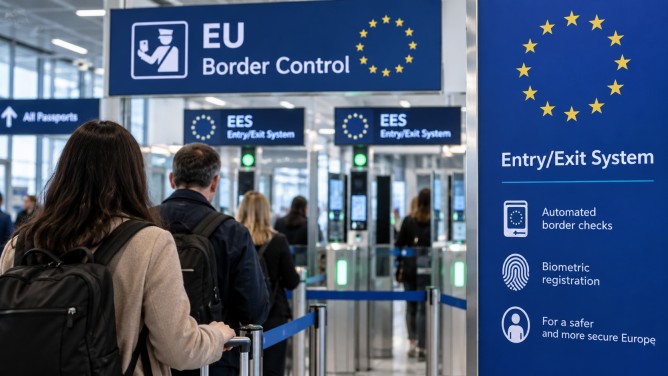
The delay in implementing the European Union’s Entry/Exit System (EES) at major border crossings could lead to longer wait times for travelers entering the Schengen area. With nine European countries, including France, Greece, Italy, and Portugal, postponing the full rollout of biometric checks, travelers may experience congestion, especially during peak travel periods.
The EES, which mandates non-EU travelers to have their fingerprints and facial images recorded upon entry, was officially launched last October. However, technical and operational challenges have hampered its widespread adoption, particularly at high-traffic airports and border points. This has prompted countries like Germany, Malta, the Netherlands, Switzerland, and Belgium to request additional time to prepare their infrastructure.
Spain stands out as a success story, having managed to overcome initial difficulties and fully implement the system. Meanwhile, some progress can be seen in places like the Eurostar terminals in Brussels and Antwerp port, where biometric checks have commenced. Major airports such as Frankfurt and Schiphol are also conducting these checks, although smaller airports continue to grapple with capacity issues.
The system has already recorded approximately 200 million registrations and has successfully blocked entry to around 70,000 individuals, including those lacking visas, overstayers, and people with forged documents. Despite these achievements, the International Air Transport Association and airlines have expressed concerns about potential travel disruptions due to the system’s implementation.
To ease the process, a pre-travel application named Travel to Europe is being rolled out. This app allows travelers to submit passport details and facial images before reaching the border, currently available in Sweden and Portugal, with plans for expansion to other countries. As authorities work to resolve these logistical challenges, travelers are advised to prepare for potential delays at certain entry points.