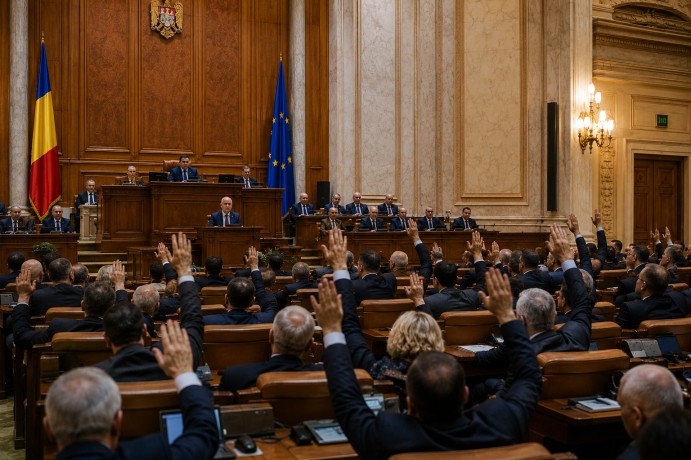
Romania’s political landscape has become more turbulent as Parliament declined to endorse the government proposed by Adrian Vestea, the Prime Minister-designate. This decision leaves the nation without a new administration for the sixth consecutive week. Vestea garnered only 189 votes, falling short of the 233 required for parliamentary approval. After the vote, Vestea expressed that he had exerted every effort to establish a government that could resolve the ongoing political instability.
The responsibility now falls on President Nicușor Dan to appoint a new prime minister-designate. The nominee will have a 10-day window to form a cabinet and secure Parliament’s backing. According to Romanian legislation, if two consecutive nominees fail to obtain parliamentary support within 60 days, Parliament may be dissolved, and early elections could be triggered.
Romania’s prolonged political deadlock is further complicated by significant economic challenges. The country is grappling with a large budget deficit and the imperative need to secure European Union recovery funds. Analysts are suggesting that forming a majority government may prove difficult due to existing political divisions, raising the likelihood of a minority administration emerging as a potential solution.
As Romania continues to navigate these political hurdles, the ability to establish a stable government is seen as crucial for addressing the economic issues at hand. The ongoing uncertainty underscores the complex dynamics within the nation’s political arena, highlighting the challenges faced in efforts to achieve consensus and move forward effectively.