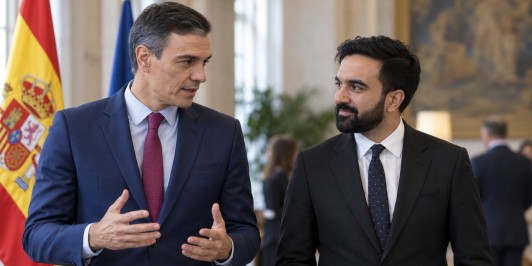
The economic strategies of Spain under Prime Minister Pedro Sánchez have showcased a potential blueprint for balancing wage increases with economic growth, a development that could inform policies elsewhere. In a recent meeting in New York, Sánchez, alongside New York Mayor Zohran Mamdani, emphasized how progressive social policies are transforming Spain, particularly through significant wage hikes and job creation.
Spain’s approach to boosting the minimum wage by 66% over the past eight years has drawn attention for its potential to uplift workers’ dignity without stunting economic growth. Mamdani commended this increase as a testament to the value placed on work and dignity, highlighting it as a model of progressive economic policy. Despite these wage increases, Sánchez pointed out that Spain has managed to be a leading force in job creation across Europe, indicating a successful integration of economic expansion and social welfare.
Further reinforcing Spain’s economic resilience, Sánchez discussed the nation’s commitment to clean energy, asserting that this shift has not compromised competitiveness. During the COVID-19 pandemic, Spain diverged from austerity measures, opting instead to prioritize support for workers and vulnerable families, a decision Sánchez defended as crucial for long-term socio-economic stability.
Immigration also played a significant role in the discussions, with Sánchez highlighting the positive contributions of migrants to Spain’s economy and social fabric. He argued that immigrants are essential to maintaining the country’s welfare system and labour market, framing immigration not as a challenge, but as a vital component of economic growth and cultural enrichment.
The meeting, which convened several progressive political figures, underscored shared goals of reducing inequality and enhancing living standards. Sánchez and Mamdani’s dialogue highlighted how Spain’s policies might serve as a roadmap for other nations seeking to address similar socio-economic issues.